|
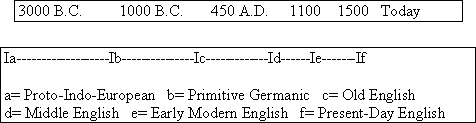
The Dialectology We Call English Linguistics 450 by Denise Erekson February 24, 1998 Light and illuminate are two English words which mean the exact some thing; one is Germanic in origin, while the other is of Latin origin. These words presently are synonyms in the English language, but they used to mean the same thing. The English language that we use today reflects many centuries of development–political and social events in history which have profoundly affected the English people have come to life through the changing language (Baugh 2). The English language has made a lot of changes since the beginning. It has had a long and colorful life. "Modern English, so far as its vocabulary is concerned, is a mixed language in which the native German elements are outnumbered by those derived from foreign tongues" (Bradley 7). This life shows the many reasons why we use the words we used and helps us understand where these words and structures come from. English comes from the Indo-European family group. It is believed that sometime between 3500 B.C. and 2000 B.C. Proto-Indo-European was spoken in Northern inland Europe (Baugh 40-41). As people separated and moved into their present locations, their dialects separated and formed into languages. One of these languages was Primitive Germanic (Baugh 35). As the people moved farther west, this language also separated and has for one of its branched English. Since that time English has continued to change as different things have happened to it. The different paragraphs below illustrate English at different stages of its life and are taken from the different translations of Boethius through out the different periods of English.
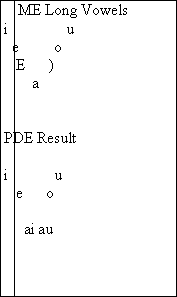
"Gif pu ponne on hwilcum men ongitst paet he bip gitsere & reafere, ne scealt pu hine na hatan man, ac wulf" (Millward 120). "For if he be ardaunt in avaryce, and that he that he be a ravynour by violence of foreyne richesse, thou schalt seyn that he lik to the wolf" (Millward 188). "The violent robber of thothers goodes is farvent in his robberyes, swellith in coueting, & mayst call him woolflyke" (Millwar 246). "You will say that the man who is driven by avarice to seize what belongs to others is like a wolf" (Millward 332). Now let us begin the story called English. OLD ENGLISH (449 - 1066 A.D.) Several centuries before the time of the Christ, the Celts settled in the land of Great Britain. They set up their own tribal kingdoms throughout the land. From 50 A.D. to 410 A.D. the Romans controlled England and ruled over the Celtic people. Then the romans had to go back to Italy to try and defend their own dying nation. They left the Celts to once again rule over themselves. Germanic tribes–namely the Angles and the Saxons–invaded and settled in England. Over a two century time period the Anglo-Saxons conquered and pushed the Celts out of England into Scotland, Wales, Ireland, and Cornwall. The Celtic languages were wiped out in England much like the American Indian languages were wiped out by English (Robinson 47). The only Celtic words left were mainly place names such as "Avon" meaning "river." From the Anglo-Saxons came the basic words for common life such as: eat, sleep, drink, love, hate, and sun. (Robinson 47). The Viking Age (850 - 1040 A.D.) brought a new invasion to England. The Vikings, or Norse, invaded the northeastern coasts of Britain. They decided to settle on the island too. Alfred the Great, a Saxon king of England, in the Treaty of Wedmore (878 A.D.), stopped the majority of constant attacks by the Norse. The Norse and the Anglo-Saxons lived in communities side by side and intermarried among each other causing them to eventually become one people. Old English and Old Norse come from the same Germanic ancestor. Both groups of people were able to understand each other because the words were very much the same. The Norse added new words into the English language which were oriented with the sea, plundering, and everyday Norse life such as: law, fish, wash, knife, scream, scout, and scorch (Robinson 49). Some of the words that were borrowed from Old Norse into Old English went through a sound change, and were later reborrowed during Early Modern English. In Old English, the English speakers took the Old Norse sound /sk/ and changed it to "sh." This would include ship, shirt, and shin. These words were reborrowed later as skipper, skirt, and skin (Webster’s College Dictionary 1207-1254). In Old English the nouns, verbs, and adverbials were all inflected. The nouns were separated into strong and weak forms; masculine, feminine, and neutral forms; and nominative, accusative, genitive, and dative cases. Each one of these cases had its own ending. One example is the word "ship" which was a strong, neutral noun. Its conjugations were scip, scip, scipes, scipe, scipu, scipa, and scipum (Millward 97). There were many strong verbs in English–this means that the vowel inside of the word changed in each of its cases. An example is the word "melt" which was in the different tenses meltan, milt, mealt, multon, and gemolten (Millward 103). However, there were more weak forms of different verbs which simply had the different endings. The adjectives compliments whatever case the noun happened to be in. Their endings were -ne, -es, -um, -e, -ra, -re, -a, and -an (Millward 99). Because of all of the different inflections found in each of the words, word order was relatively free. The most common word order was SVO (Subject, Verb, Object); although, they could use any other order which they wished. VSO was also somewhat common. The inflections of the words were what gave it its proper meaning in the sentence. There were some new sounds introduced into Old English: "ch," "j," and "sh." These sounds are all palatal fricatives and affricates. MIDDLE ENGLISH (1066 - 1500 A.D.) In 1066 William the Conqueror, Duke of Normandy, invaded England to claim his right to the English throne. The Anglo-Saxons were celebrating their victory over some Vikings from the north wen they were attacked and ambushed in the south. The French had come to town and were there to stay. Within the next few decades the Normans had taken over all positions of power. They had also brought in the feudal system and made the Anglo-Saxons servants under them. For the next two hundred years all of the educated people spoke French. English was spoken by the uneducated common people. It was simplified and changed in many ways since it was only a spoken language. Then the English nobles started to speak English themselves. This happened because King John of England lost Normandy which caused families to decide to be either French or English; and the Plague killed so many peasants that their status rose. The Normans added many new words dealing with the upper-class such as: battle, peace, beauty, jewel, satin, beef, and judge (Robinson 54). "V," voiced "th," and "z" became distinct sounds in English during this time period. These were all the voiced counterparts of Old English’s fricatives. Middle English had lost most of Old English’s inflectional endings. The nouns had changes to just have three endings (one for singular, one for plural, and one for genitive). One example is name, names, and names. THE GREAT VOWEL SHIFT Sometime between Late Middle English and Early Present-Day English the English long vowel system completely changed. No on is sure why this occurred or the precise stages that it went through; although, there are several theories about this occurrence, but I won’t go into a single one here. The shift could have been the vowels shifting up into the next slot with the top vowels moving to the bottom (as our spelling suggests when compared with the phonetic system of other European languages) or the other way around. We know that the sound change did occur, and that it only affected long vowels. This change didn’t affect every long vowel either, as there are some exceptions like "Reagan" (Pyles 172-175). Above is a chart of the sounds before the change and after the change.
EARLY MODERN ENGLISH (1500 - 1800 A.D.) When the Renaissance came to England it created quite a stir. No longer did the language just have to deal with farming, feudal systems, market days, and church on Sundays. Suddenly, it found itself having to deal with every topic under the sun. The scholars had always learned and written Latin. Books were fairly scarce because it took so long to copy them out by hand. In 1476 William Caxton introduced the printing press to England. Now all of the books could be mass produced for the benefit of all the people (the middle-class was rising too during this time period and could afford to buy the books). The English language couldn’t handle all of the new pressures that were then being put upon it. Many of the translators who translated Latin works into English just copied the Latin words exactly as they found them. Latin and Greek entered the language directly during this time period. There words were now long, scholarly words such as: democracy, skeleton, circulation, mathematics, necessary, intellect, and individual (Robison 59). The Latin words added a formality which seemed to remove the speaker away from what he was speaking about; for example take the difference between grow and develop, smart and intelligent, teach and instruct, heart and cordial, and earth and geography. These words all show the difference between the informal, ignorant, and common and the formal, scholarly, and upper-class (Robinson 62-63). During Early Modern English the people began to separate the sounds "ng" and "zh" from "n" and "sh" respectively. Sounds began to be lost during this time such as the "k" in "knight" and the "g" in "gnaw." They also began to lose "l" after low back vowels, "r" when in consonant clusters or at the end of a work, and /j/ after alveolar sounds (Millward 251-253). At this time the spelling of words and the punctuation of sentences became fixed. No longer could one see various spellings of the same word in the same document. The punctuation would follow the models of Continental printers (Millward 262). Kthe introduction of the printing press had created a need to have a standard spelling and punctuation system. Inkhorn terms (words taken directly from Latin into English) created a great need for dictionaries so that the common person could find out the meaning of words that were just being introduced into the English language (mainly for people who had not learnt Latin). The dictionaries gave definitions and sometimes etymologies of the words (Millward 241). Early Modern English saw a few changes in morphology. There was no longer a separation between strong and weak verbs in English because most of the verbs had become weak. The possessive started to have a regular form of " ‘s" (Millward 266-275). It was also during this time period that syntax became more Latinized. "English came to be characterized by long, heavily subordinated, periodic sentences and by such devices as parallelism, couplets, balanced clauses, and use of absolute participles" (Millward 282). The sentences were longer and indeed had many more clauses in them; however, the punctuation became more standardized as a result. One Latin rule is not to end a sentence with a preposition like "He came in"; instead say "He came in the room"; although, I can completely understand both of them. PRESENT-DAY ENGLISH (1800 - TODAY) Today English has been influenced by many sources. It currently has more words with Latin roots that Latin ever had as a language. "Our literary vocabulary abounds with words which owe their mental effect not to any English traditions, but to the reader’s knowledge of the Latin etymology" (Bradley 95). Words for all of the new technology which the world has recently come across seem to bear Latin as their main source of roots, alsong with some other sources. These words would include: telephone, computer, cyberspace, automobile, alpha test, fusion, and psychoanalytical. The British also had created settlements and conquered people all over the world. They had the Empire of the Sun because the sun never set upon some part of the British Empire. English settlers lived in Canada, the United States, and Australia, in addition to the British Isles. The British had also taken control of South Africa India, parts of China, and different island s in the Pacific. English borrowed words from nearly all of the different languages that it came in contact with. Some of these words include: boss, poppycock, tomato, kindergarten, ski, boondocks, and pajamas (Millward 329-330). There is also the flush of slang words which have entered the language and become part of common speech like: crush, groovy, kickin’, phat, and like. One new allophone was introduced into the English language during this segment of history. A glottal stop has become common in many different varieties of English as an allophone of "t" such as "butter" (Millward 311). Maybe someday it will become its own sound. Nouns have changed a little int his modern era with their genitive form and in the second person. Group genitives are now widely used such as "the flower in the doorway’s vase." We also use "of" to show possession like in "the vase of the flower in the doorway" (Millward 315). Also, in the second-person, pronouns are the same whether they are singular or plural; we use the common word "you" for both of these. As a result of this, verb phrases lost the inflection -st (Millward 317). The sentence order of Present Day English is exactly the same as it has been since Middle English times. We get our meanings across by the order in which the words locate themselves. "I like pears" means something entirely different from "Pears like me." CONCLUSION Like the differences between the different paragraphs in the first section, English has come a long way in its development. It is a living language which means it is always in a state of constant change. Speakers of Old English would have as little luck understanding what we are saying and writing as we would have if we were to listen to them. Proto-Indo-European–Germanic–English. These are the stages of growth which went together to form which is English. English has most of its grammar rules taken from German (Bradley 1-4) and most of its words are actually French in origin (Baugh 200-201). It has since borrowed from every civilization that it has come into contact with since it first became a language. Everything has been meshed together so that Englishmen throughout the ages could communicate and understand every other people that they have come into contact with. Then their children speak the language that was created as if they were natives of it. Do we speak a separate and distinct language, or just a jumbled version of Post-World?
Works Cited Bradley, Henry. The Making of English. London: Macmillian & Co Ltd, 1957. Millward, C.M. A Biography of the English Language. Fort Worth: Harcourt Brace College Publishers, 1996. Pyles, Thomas and John Algeo. The Origins and Development of the English Language. New York: Harcourt Brace Jovanovich, Inc., 1982. Random House Webster’s College Dictionary. New York: Random House, 1996. Robinson, Sandra R. Origins: Bringing Words to Life. vol. 1. New York: Teachers & Writers Collaborative, 1989. |